When a 112 operator takes a call from someone trapped in a storm, the caller's words are there, even though they can be almost intelligible. They're buried under the sound of wind, traffic, panic, or crowds. The information that saves a life is in the signal. The problem is getting it to the operator's ear, clearly, in time.
That's the problem Sharpi was built to solve.
Not to just remove or "cancel out" the noise, but to isolate and clear up speech. The difference between the two is what can enable operators to catch every word, in every situation.
In this blog, we'll explain the difference between noise cancellation and modern, AI voice isolation, how the technology works, and why it matters.
What is AI speech enhancement?
AI speech enhancement is technology that uses artificial intelligence to make a human voice clearer in a noisy recording or call, in real time. Instead of simply lowering background sound, it identifies the speech in an audio signal and reconstructs it - so the voice comes through clearly, even when the environment around it is loud, chaotic, or unpredictable.
How is speech enhancement different from noise reduction?
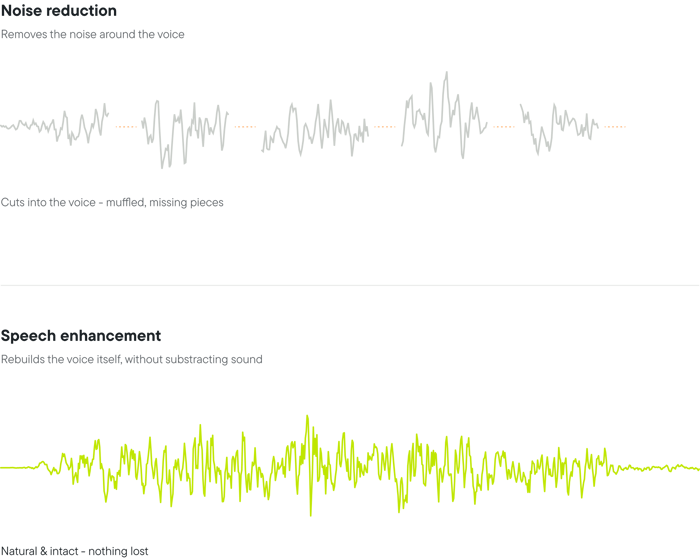
For a long time, the standard solution to noise in emergency or service calls were noise reduction or suppression - it estimates the background noise and strips it out. And this works, to a point. Because it treats the voice and the noise as one signal that has to be turned down, together, audio that has been through noise reduction often sounds heavily processed, muffled, or "under water".
AI speech enhancement takes the opposite approach, separating and rebuilding the voice and making it clearer, rather than just removing the noise around it.
What does it mean to separate voice from noise?
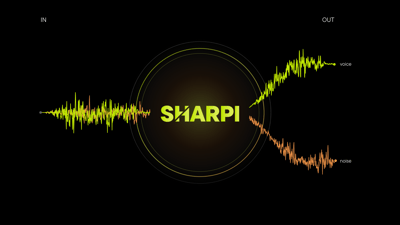
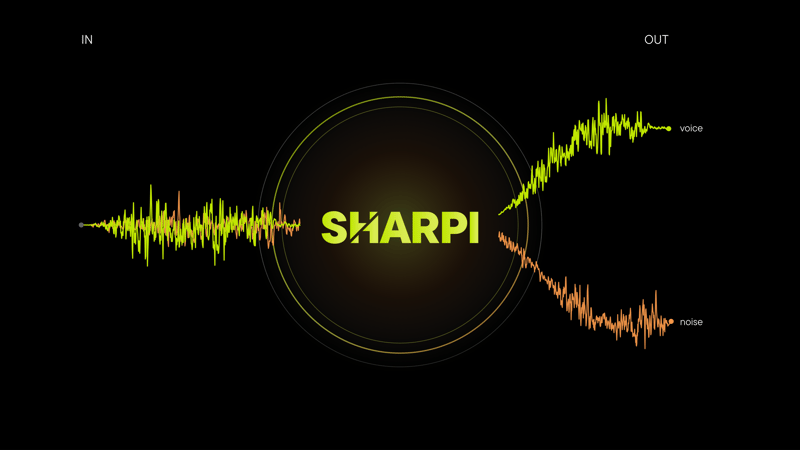
Sharpi is AI Speech Enhancement. It separates speech from everything else in a sound, in real time, and splits the two apart - so you keep full control over what you want to hear, and when.
Here's the distinction that matters: Old approaches turn the volume down on everything and hope the voice survives. Sharpi does the opposite. It identifies the voice, holds onto it, and lets you decide what happens to the rest. The voice doesn't get quieter along with the noise. It gets clearer.
That control is the part people miss. In an emergency call, you don't always want silence behind the caller.
The background can tell you something - is it a crime scene, is the caller near a road, is there a struggle going on, or is someone in the background sharing essential information?
Sharpi keeps that situational awareness intact while it lifts the speech to the front.

Why does clear speech matter on a call?
Sharpi was originally built by audio engineers to help 112 operators hear every word of every emergency call. It’s already in use across 112 centres throughout Europe, proving itself on real calls every day. When operators can hear clearly, they make fewer mistakes, ask “sorry, could you repeat that?” far less often, and carry a much lower cognitive load over the course of a shift.
Does removing noise mean losing detail?
This is the fear, and it's a fair one. Aggressive noise suppression often cuts into the voice itself, leaving speech that sounds muffled. Sharpi is built to avoid exactly that. Because it reconstructs the voice rather than just subtracting noise around it, the speech stays natural - and because you keep control of the background, you don't lose the acoustic context that tells you where a caller is or what's happening around them.
Where does the audio go when it's processed?
Nowhere. Don't worry.
Sharpi's AI is self-contained. It can run on-premise and offline - blurred speech in, crystal clear speech out, with no audio sent anywhere to be processed. For 112 centres, hospitals, and any team handling sensitive calls, it's important to know that all the audio going through is not being transferred to a cloud somewhere, or being stored and processed outside safe local systems.
How can AI "hear like a human"?
Your brain is extraordinary identifying which noises are important, and where to focus your attention in a conversation. In a loud room, you can lock onto one voice and let the rest fade. This is often called the cocktail party effect. You don't process every sound equally. You decide what matters and your hearing follows, filtering out everything that is not essential for you.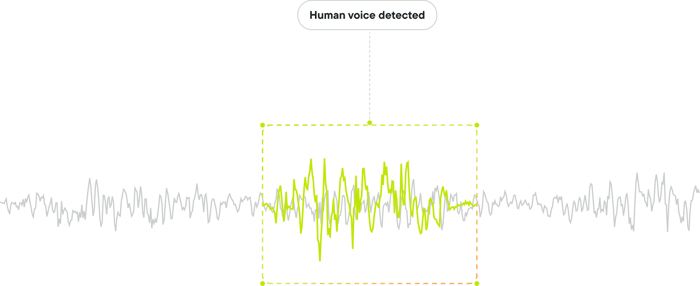
Sharpi was built to work the same way. Not to clean up a signal like a machine, but to focus like a listener. It was trained, specifically, to hear the way people hear; to catch the sound of a voice that a human would focus on, and to treat the rest as background.
This is why, when we explain how Sharpi's speech enhancement works, we say that it's AI "trained like a brain. The goal was never to just "process audio". It was to make it "hear like a human", to support the operators, and help them control exactly what sounds - and noises - to focus on.
How does AI recognise a human voice in background noise?
To understand how AI can learn to recognise human voices, think of how your own brain processes sound. If you are in public, having a conversation, every sound is hitting your ears at once. The brain knows, instantly, which sound is a human voice and which is wind, traffic, or a slammed door. You never think about it. That recognition is one of the most sophisticated things the brain does - and it's exactly what we taught Sharpi to do.
It learned the way we learn: by listening. Sharpi's neural network trained on more than 25 years of real voices - not clean studio speech, but the messy, accented, interrupted, overlapping way people actually talk. That's why it recognises human speech itself, rather than memorising particular words or phrases. It's tuned to the sound a person makes, the same cue your brain locks onto.
Does AI speech enhancement work in every language?
Your brain doesn't need to know a language to recognise that someone is speaking it. A voice in a language or dialect you've never heard is still, unmistakably, a human voice - you hear the person before you understand the words. That instinct is universal, and it's the one Sharpi is built on. Because you need to be able to hear the caller clearly, even if the person slurs, or doesn't speak your language.
This works, because we didn't train Sharpi on vocabulary. We trained it on the sounds humans make - across more than 25 years of real speech, in real conditions, in many languages, with people speaking fast and slow. So instead of listening for particular words, Sharpi recognises human speech itself and lifts it out of the noise.
In a real life context, our automatic voice enhancement and language detection has saved lives, and enabled operators to not only hear the person clearly, but also determine how to forward the call to someone who understands the caller, in seconds.